Sustainable Land Use Framework
What is the Sustainable Land Use Framework?
The Sustainable Land Use Framework (Framework) is a holistic policy approach intended to balance community priorities, guide future policymaking, and meet the goals of the County's Board, the governing body for the unincorporated area.
2026 PROJECT UPDATES
Two (2) Board of Supervisor hearings relating to the Sustainable Land Use Framework (Framework) are anticipated in 2026, with a series of engagement activities taking place ahead of both hearings. Information on these events are located on this project webpage.
Based on extensive community input, County staff is exploring opportunities to bring forward options for a Sustainable Land Use Framework with a key mechanism being the opportunity to update the County’s General Plan for alignment with the key sustainability principles and focus areas of the Framework. At this time, discussions about a General Plan update are conceptual and exploratory. If directed to proceed with an update, the County will undertake substantial outreach and all required consultations.
Hearing #1: June 10, 2026
Vehicle Miles Traveled (VMT) is closely connected to sustainability because the intent of VMT policy is to reduce sprawl and encourage less driving, which can reduce greenhouse gas (GHG) emissions. VMT policy can influence our overall land use patterns, including access to jobs, transportation, and can guide where housing should be prioritized. Due to VMT’s connections to sustainability, the Framework is working closely with the VMT team and will have a shared touchpoint with the Board of Supervisors in summer 2026. At that hearing, approaches to providing VMT mitigation will be discussed, including the option to integrate VMT into the General Plan to support the Framework goals and objectives. Ahead of this hearing, a series of public and focused stakeholder webinars, including a tribal-specific webinar will be hosted to explain the intent of this hearing and set the foundation for a more in-depth hearing on the Framework in the fall.
Hearing #2: Fall 2026
A second hearing on the Framework will be presented to the Board of Supervisors in Fall 2026. At this hearing, staff will review the opportunities and potential outcomes that could be achieved from an update to the General Plan, focusing alignments for sustainability and equity.
Why is there Need for the Sustainable Land Use Framework?
In recent years, the State of California (State) has passed various laws related to housing, climate change, development, and sustainability. Many of these laws attempt to address the simultaneous housing and climate crises, with some laws seeking to redirect development in ways that can lessen the associated environmental impacts. For example, the State has been encouraging development within areas with access to transit, services, and amenities with the goal of reducing greenhouse gases.
The Framework can be the more adaptable and holistic lens used for sustainable planning and development to ensure that ALL unincorporated communities (regardless of proximity to transit, services, and amenities) can live, evolve, and thrive in an equitable and sustainable way. The Framework is not intended to duplicate or conflict with the General Plan but rather identify and address any gaps to help the General Plan (the County’s guiding planning document) evolve with new State legislation and adjacent planning efforts.
The Framework is being developed through a step-by-step approach to ensure it is responsive to feedback and comprehensively built through a structured, inclusive, and transparent process. Visit Learn More About the Project Steps on the right-side to read more about each of the project steps.

We Want You Involved!
- Sign up to receive updates and stay involved in the process by subscribing here!
- Upcoming engagement opportunities and events (virtual and in-person) will be shared on this site
- Reach out to anyone on the project team or by using the "Ask a Question" tool below to get in touch
- Your ideas and feedback will help shape how the County approaches land use more sustainably and equitably for generations to come
-
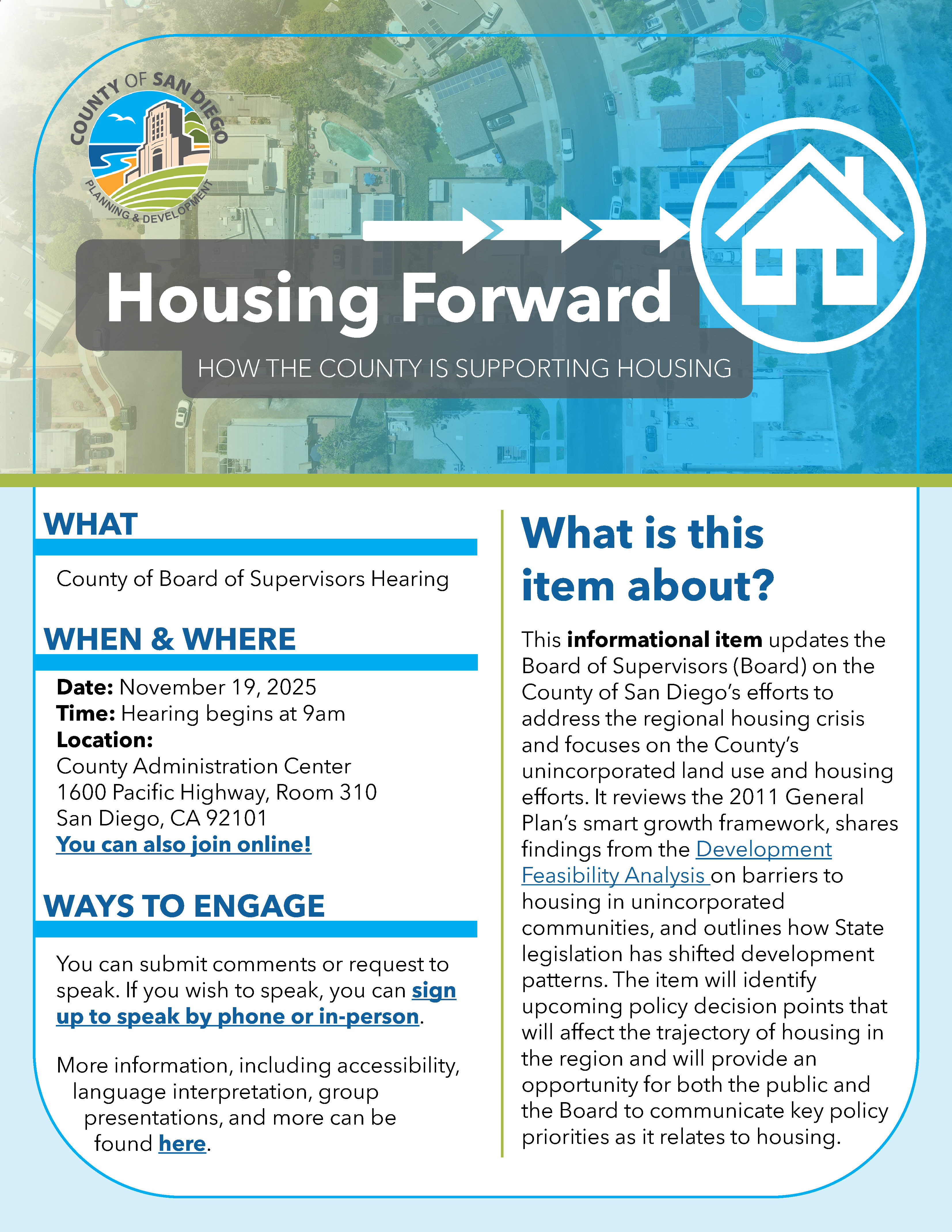
11/19/25 Board of Supervisors Hearing: Housing Forward
Share 11/19/25 Board of Supervisors Hearing: Housing Forward on Facebook Share 11/19/25 Board of Supervisors Hearing: Housing Forward on Twitter Share 11/19/25 Board of Supervisors Hearing: Housing Forward on Linkedin Email 11/19/25 Board of Supervisors Hearing: Housing Forward linkStaff from Planning & Development Services and Housing and Community Development Services will present at a Board of Supervisors meeting on November 19, 2025, to provide an update on the regional housing crisis and focus on the County’s unincorporated land use and housing efforts. It reviews the 2011 General Plan’s smart growth framework, shares findings from the Development Feasibility Analysis on barriers to housing in unincorporated communities, and outlines how State legislation has shifted development patterns. The item will identify upcoming policy decision points, including the Sustainable Land Use Framework, that will affect the trajectory of housing in the region and will provide an opportunity for both the public and the Board to communicate key policy priorities as it relates to housing. Note, this is not intended to be a milestone hearing for the Framework and does not include Board direction at this time.
-
Stakeholder Group & Community Planning Group Meetings
Share Stakeholder Group & Community Planning Group Meetings on Facebook Share Stakeholder Group & Community Planning Group Meetings on Twitter Share Stakeholder Group & Community Planning Group Meetings on Linkedin Email Stakeholder Group & Community Planning Group Meetings linkFive stakeholder groups representing Land Development, the Building Industry Association (BIA),Environmental Coalition, Labor Union, and Farm Bureau, along with several Community Planning Groups are receiving updates on the Sustainable Land Use Framework.
The presentation slides and the one-pager these groups received can be found on the right in the "Key Dates & Milestones" section as well as included below.
Link to the Presentation
One-Pager:


Raw text from the one-pager is copied below for translation purposesThe Sustainable Land Use Framework
What is the Sustainable Land Use Framework?
The Sustainable Land Use Framework (Framework) strives to identify where and how development can occur sustainably and equitably and provide a comprehensive and holistic approach to address the housing crisis, transportation, human health and equity, economic prosperity, climate, the natural environment, and natural hazards such as wildfire.Focus Areas, Goals, and Objectives
The Framework’s Focus Areas and the drafted Goals & Objectives were created in collaboration with the community, County departments, and other stakeholders. The Goals & Objectives are under review and may change prior to being finalized and shared with the Board of Supervisors in summer 2024.Focus Areas (bolded) & Draft Goal Draft Objectives Housing
Accessible, Inclusive, and Sustainable Housing
- Increase the Availability and Affordability of Housing
- Increase Mixed-Income Housing and Communities
- Create Sustainable and Resilient Housing
- Reduce Regulatory and Municipal Service Barriers to Sustainable Housing
- Protect Against Displacement
Transportation
Equitable, Sustainable Transportation Options
- Increase Rural Accessibility to Decarbonized Modes of Transportation.
- Facilitate Sustainable and Complete Community Development.
- Increase Efficient and Accessible Active Transportation (e.g., walking, biking, rolling)
- Increase Connectivity and Development Within and Between Transportation-Efficient Areas
Human Health & Equity
Equitable, Inclusive, & Adaptable Planning
- Provide Equal Access to Decision-Making Processes
- Ensure Shelter is Available to All
- Protect and Improve Accessibility to Basic Human Needs (e.g., healthy air, water, food)
- Expand and Enhance Community Amenities to Increase Cultural Cohesion (e.g., parks, community centers, community gardens)
- Preserve Historic and Cultural Communities to Deter Displacement
- Streamline Accessibility to Quality Goods and Services
Economic Strength
Environmentally Sustainable Local Business Growth and Employment
- Increase and Encourage Green Economic Opportunities
- Preserve Agricultural and Working Lands and Associated Workforce Opportunities
- Incentivize Locally Owned Businesses and Local Commercial Areas to Serve Communities
- Promote Circular Economies and Efficient Use of Resources
Natural Environment
Sustainably Functional Natural Environments
- Protect, Restore, and Enhance the Function of the Natural Environment
- Ensure Equitable and Sustainable Access to Natural Spaces and Resources
- Create and Maintain Space for Connected Natural Networks and Diverse Habitats
- Integrate Innovative and/or Nature-Based Infrastructure Into Urban and Built Environments
Natural Hazards
Wildfire & Hazard Resiliency
- Assess Natural Hazards (e.g., wildfire, heat, flood) and Develop Strategies to Reduce Risk
- Integrate Nature-Based and Innovative Solutions to Reduce Vulnerabilities and Exposure to Hazards
- Ensure Development is Informed by Potential Hazards
- Build Resilience with Communities in Hazard Areas
Climate
Climate Mitigation & Adaptation
- Reduce Greenhouse Gas Emissions from Human Activities
- Promote Sustainable Living
- Advance Transition to Efficient and Renewable Energy
- Create Communities that are Adaptable and Resilient to the Impacts of Climate Change
- Expand Carbon Capture and Storage
Framework Timeline
2023 2024 2025 Sustainable Land Use Principles (Sustainability Principles) Focus Areas, Goals, and Objectives
Approaches, Mechanisms,
and OptionsBoard of Supervisors - Preliminary Approval of Sustainability Principles
Completed March 2023
Board of Supervisors - Informational
Upcoming - Summer 2024
Board of Supervisors - Selection of Options and Implementation Mechanisms
Pending Recommendation
Note: Dates and details are subject to change
Questions? Email Julie Marlett at JulieK.Marlett@sdcounty.ca.gov
Who's Listening
-
For general project questions: